Places
Things to Do in Stavanger Before or After Pulpit Rock
Most Preikestolen days begin and end in Stavanger. The express buses to the trailhead leave from the city centre, the Lysefjord cruise sails from Strandkaien by the Fish Market, and the cruise terminal is within walking distance of the express-bus departure point. That makes the city the natural base, and it means you will usually have a morning, an evening or a whole spare day to fill around the fjord.
The good news is that the best of Stavanger is compact. The old wooden town, the medieval cathedral, the harbour, the colourful street and the Petroleum Museum are all within a short walk of each other, and the beaches and Viking sites are a bus ride away. This guide is a planning piece for that spare time: what is worth seeing, how long it takes, what works in the rain, and how it fits around a hike or a cruise. Opening hours and prices are given only where the operators publish them, and they change, so check before you go.
The short answer
- Old Stavanger: 173 white wooden houses by the harbour, free to wander, with two museums.
- Stavanger Cathedral: Norway’s best-preserved medieval cathedral, a few minutes from the harbour.
- The Norwegian Petroleum Museum: the city’s big museum, and the best choice for a wet day.
- Vågen and the Fish Market: the harbour, fish soup and fishcakes.
- Øvre Holmegate: the street of colours, with cafés and bars.
- Swords in Rock and the beaches: Viking history at the Hafrsfjord and long sandy beaches at Sola and Jæren.
Stavanger as your base for the fjord
It helps to know where the fjord trips start before you plan the rest.
- The express buses to Preikestolen leave from the centre. Go Fjords meets at Olav V’s gate 3, outside the Radisson Blu Atlantic, and Pulpit Rock Tours stops there and at the bus terminal. On a typical summer day, the 09:00 Go Fjords bus is back in Stavanger at 16:00.
- The Lysefjord cruise leaves from Strandkaien, in the centre close to the Fish Market, on a round trip of 3–3.5 hours. In summer it sails at 10:00, 12:00 and 14:30.
- The cruise-and-hike leaves Strandkaien at 10:00 from May to September, and at 11:00 in October, and returns by bus in the evening.
- Guided hikes collect you from your hotel or the cruise port; our guide to Pulpit Rock tours compares them.
So a hiking day leaves you the evening, a cruise leaves you half a day, and a rest day leaves you the whole city. Our guide to getting to Preikestolen covers the buses, and our Lysefjord cruise guide the boats.
Old Stavanger (Gamle Stavanger)
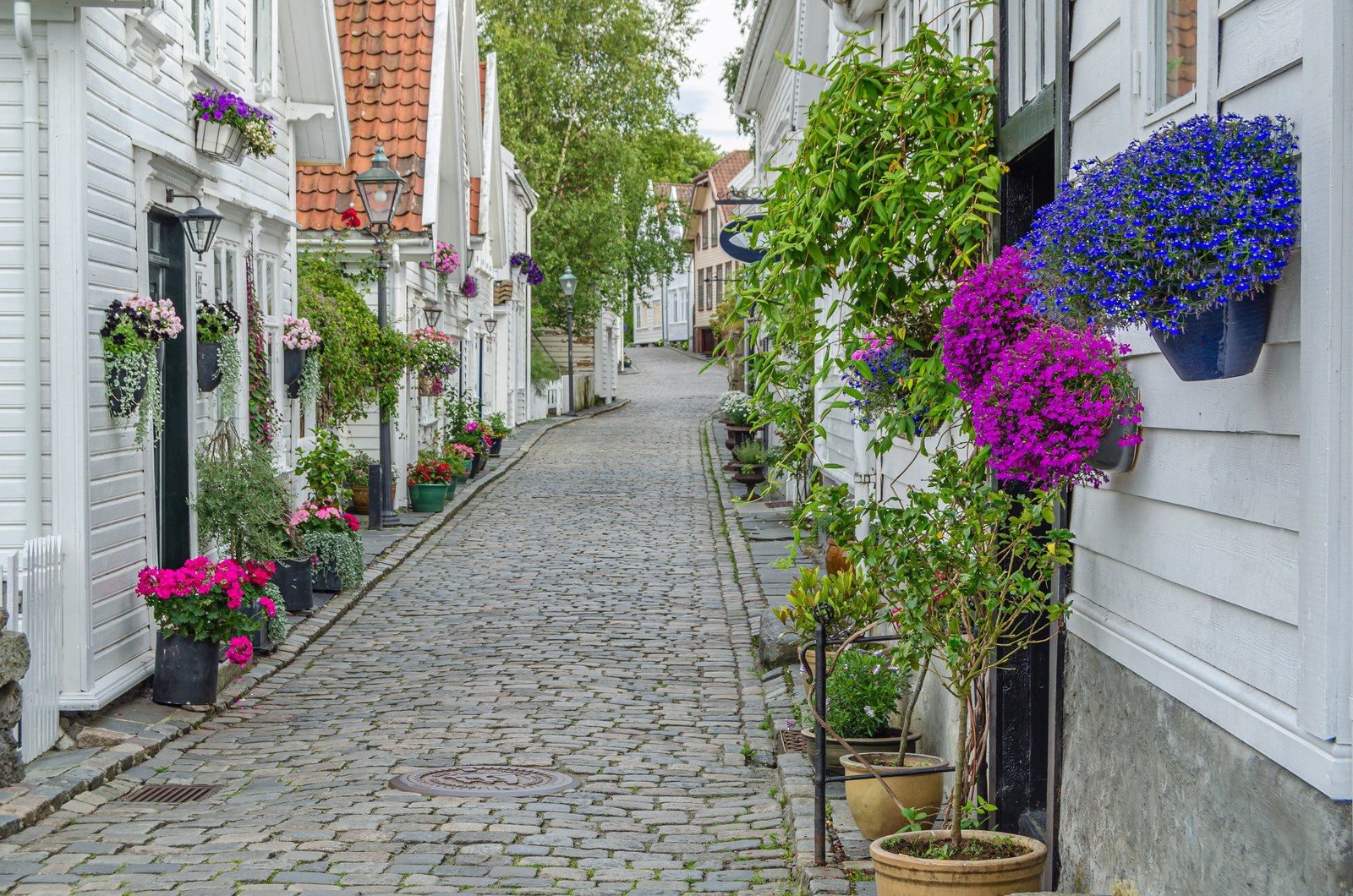
The old town is the first thing most visitors want to see, and it costs nothing. Gamle Stavanger, also known as Straen, is a small district just west of the harbour of 173 wooden houses from the 18th and 19th centuries, most of them painted white. Fjord Norway describes them as small and slightly crooked, with gardens and window boxes that fill with flowers from spring through summer. The cobbled, pedestrian-only Øvre Strandgate runs through the middle.
A little history makes the walk more interesting:
- Who lived here. In the herring heyday the houses were home to labourers who worked in the herring and canning factories or at sea, often with many people under one roof.
- The Stavanger arch. Several houses have a flat-topped, asymmetric extension on the roof, built to make room for more tenants and known as the Stavanger arch.
- Houses that moved. Built of logged timber, the houses were easy to dismantle, and several were brought here from somewhere else when their owners moved.
- Saved and protected. The houses are protected and a few are listed. Old Stavanger was one of three Norwegian pilot projects in European Architectural Heritage Year 1975, a Council of Europe campaign.
Old Stavanger is also the small showpiece of a much larger wooden city of around 8,000 houses. One request from the tourism board is worth repeating: these are people’s homes, so respect private property and residents’ privacy.
Two museums in the old town
Both belong to MUST, and one MUST ticket gives entry to all its museums open on the same day. As listed, an adult ticket costs NOK 170, and under-18s and students go free.
Stavanger Maritime Museum, at Strandkaien 22, fills several merchants’ houses built in the early 1800s. You walk through a general store, a shipping office, a merchant’s apartment and a sail loft, and the exhibitions cover the last 500 years of maritime history, craft and trade. On the first floor, “Working at the docks” is a role-play exhibition for children set in the late 1950s.
IDDIS, the Norwegian Printing Museum and the Norwegian Canning Museum, at Øvre Strandgate 88, occupies an old canning factory and a new building. Iddis is the Stavanger word for the labels on tins, and the canning industry’s need for colourful labels is what built the city’s printing industry. Through the year the smoke oven in the old factory is lit and you can taste freshly smoked sprats. Next door, the workers’ house at No 90 was built in 1836 and shows interiors from 1920 and 1960, and the IDDIS café has an outdoor terrace between the museum buildings.
Stavanger Cathedral
A stone’s throw from the harbour, Stavanger Cathedral is bound up with the founding of the city. According to tradition it was built in 1125, when Sigurd Jorsalfarer made Stavanger the seat of a bishop, and 1125 is also counted as the year the city was founded; Store norske leksikon notes that the dates are uncertain and that the church was most likely built in the first quarter of the 1100s.
What you see:
- A Romanesque nave, the oldest part, built in Anglo-Norman style, probably by English craftsmen, under Bishop Reinald of Winchester.
- A Gothic choir and two towers from the middle of the 1200s.
- A rare survivor. Fjord Norway calls it the only Norwegian cathedral from the Middle Ages that has kept its original architecture, and the only one in continuous use since the 14th century.
The cathedral is dedicated to St Swithun and seats about 750. It was restored between 2015 and 2024 and reopened to mark the 900th anniversary of the church and the city. As listed by the tourism board, tourists and visitors have paid NOK 75 since 1 October 2024. It is open all year but closes to the public during other events, so check its own website for the day’s hours.
The Norwegian Petroleum Museum
You cannot miss it: the museum on the harbour promenade at Kjeringholmen is shaped like an oil platform. Fjord Norway calls it one of the most popular museums in Stavanger. Its exhibitions show how offshore oil and gas became Norway’s most important industry: how they form, how they are found beneath the seabed, how drilling and production work, how oil revenue changed Norwegian society, and the climate challenge it poses. There are interactive installations, films and activities for children and adults.
As published by the museum:
| 1 September to 31 May | Monday to Saturday 10–16, Sunday 10–18 |
| 1 June to 31 August | Every day 10–19 |
| Adults | NOK 180 |
| Children aged 4–16 | NOK 60 (under 4 free) |
| Family (two adults, three children) | NOK 420 |
| Students / pensioners from 65 | NOK 90 / NOK 140 |
It is closed on 24, 25 and 31 December, 1 January, Good Friday, Easter Sunday and 17 May. The restaurant Bølgen & Moi is in the same building, which makes it an easy lunch stop.
Vågen and the Fish Market
Vågen, the harbour, is the centre of town: mainly the quays of Strandkaien and Skagenkaien, with restaurants, pubs and shops along the water and the tourist office close by. Around 60 old wharf houses line the harbour, built at the end of the 18th and start of the 19th centuries; many of the former sea houses are now restaurants and bars. In the evening you can follow the blue lights set into the ground along the water, the walk the city calls the Blue Promenade.
Fisketorget, the Fish Market, at Strandkaien 37, is both a fish counter and a restaurant. The counter sells shrimp, crab, whole fish and fillets, and more unusual seafood such as scallops, oysters, lobster, herring dishes and bacalao. Fjord Norway calls the soup at its restaurant Stavanger’s most famous fish soup, and says locals buy freshly made fishcakes from the counter to eat on the go. It is also next to where the Lysefjord boats leave, so it suits a meal before or after a cruise.
Øvre Holmegate, the street of colours
Øvre Holmegate was once a quiet, rather dull street. The idea of renewing it came from a local hairdresser, Tom Kjørsvik, and the artist Craig Flannagan designed the colour scheme for the houses; the whole process took more than four years. Locals call it Fargegata, the street of colours. It has been closed to cars since 2005, and its cafés, bars and small shops make it one of the city’s main attractions; the tourism board calls it probably one of the most Instagram-friendly places in Stavanger.
Stavanger’s street art goes further. The Nuart festival has made the city the best-known destination for street art in Norway, and works by well-known artists are spread around the centre. Keep an eye out, too, for Antony Gormley’s cast-iron figures: there are 23 of his “rusty men” around the city, part of his work Broken Column.
Two towers
Two towers are worth the detour.
- Valbergtårnet was built from 1850 to 1853 as the town’s observation tower for its watchmen. The watchmen lived there and raised the alarm when fire broke out; the last of them, Tobias Sandstøl, served until 1922, and the children’s author Torbjørn Egner is thought to have had him in mind for the watchman in his story of Kardemommeby. There is a small watchmen’s museum on the first floor.
- Våland tower, from 1895, stands on top of the Våland district with a viewpoint over the whole of central Stavanger. From there you can walk on through the woods to Lake Mosvatnet and the Stavanger Art Museum on its west bank.
Fjord Norway’s own highlights walk links Old Stavanger, the Fish Market, the cathedral, Valbergtårnet, Fargegata and the city lake, Breiavatnet, in about 4 hours at a calm pace.
Viking Stavanger: Swords in Rock and Viking House
Swords in Rock (Sverd i fjell) stands on the shore of the Hafrsfjord, just outside the city. Three swords set into the ground mark the battle in which, the saga says, Harald Fairhair gathered Norway into one kingdom in 872. They stand for peace, unity and freedom, their hilts are taken from swords found in different parts of the country, and the sculptor Fritz Røed’s monument was unveiled by King Olav in 1983. Fjord Norway is candid that the date is not confirmed and could as easily be the 880s, and that divers have found no remains of the battle. There is a bus from Stavanger, a walking and cycling path of nearly 9 km along the fjord, and, in summer, a family bathing beach at Møllebukta.
Viking House tells the same story with virtual reality: you board a Viking ship and watch a film about Harald Fairhair and the battle of Hafrsfjord.
Beaches: Sola and Jæren
Stavanger is a city on the open coast as well as the fjords, and on a fine day the beaches are a good contrast to the mountains.
- Solastranden, by the airport at Sola, is the best known. Planes land over it, the Sunday Times once named it one of the most beautiful beaches in the world, and it came top of a national ranking of Norway’s beaches in 2006. The Museum of Aviation History is nearby.
- The Jæren beaches, further south, are Norway’s longest sand beaches and part of a protected landscape area, where all visits must be on foot. They are signposted, and some are easy without a car: Brusand is about 45 minutes from Stavanger by train, Ogna 50 minutes, and bus 8 runs to Viste.
Fjord Norway describes a coast shaped by the raw forces of nature, worth visiting in good weather and bad, so dress accordingly.
When it rains
Stavanger has plenty of indoor options, which matters in a region where the weather changes quickly. The best:
- The Norwegian Petroleum Museum, with a restaurant in the same building.
- The MUST museums, on one ticket on the same day: the Maritime Museum and IDDIS in the old town, among others.
- The cathedral, outside events.
- Viking House, for the virtual-reality Viking story.
- Stavanger Art Museum by Mosvatnet, and the Museum of Archaeology on the edge of Våland.
- A floating sauna. DAMP sauna floats on the waterfront in the east of the city, and a dip in the sea is part of the experience.
- Vitenfabrikken in Sandnes, a combined museum and science centre.
A rainy day is also a good day for the Lysefjord cruise rather than the hike. The boat sails in the rain, though from October to March only from Thursday to Sunday, apart from the days between Christmas and New Year, and you can watch from the lounge through panoramic windows.
Food and drink
Stavanger takes food seriously. Fjord Norway notes that it is one of the few cities in Norway with several Michelin-starred restaurants, and its suggestions range from that end of the scale to a fishcake eaten on the quay.
- Seafood at the harbour: the Fish Market’s restaurant, whose menu is based on the day’s catch, and its counter.
- Museum lunches: Bølgen & Moi at the Petroleum Museum and the IDDIS café in the old town.
- A view with dinner: Spiseriet, in the foyer of Stavanger Concert Hall, looks out over the fjord.
- Gladmat, Norway’s largest food festival, fills the harbour and city centre for four days in summer. The next edition runs from 23 to 26 June 2027; the festival area is free, though some events need a ticket.
Before a hike, buy your packed lunch in town. There is no food or water on the Preikestolen trail, and while Preikestolen BaseCamp has a café and restaurant at the trailhead, you will want snacks and water with you from the start.
Fitting Stavanger around the fjord trips
A few ways to combine the city with Preikestolen and the Lysefjord:
- Arrival day: walk the harbour, Old Stavanger and the cathedral, and eat at Vågen. It is a gentle way in, and you can collect any kit you need: Fjord Norway recommends Fjällräven, Skogstad and Helly Hansen for outdoor clothing.
- Hike day: take a morning bus or a guided hike with pickup, and you are back in time for dinner. Keep the evening easy.
- Cruise day: take the 10:00 cruise and spend the afternoon at the Petroleum Museum or on Øvre Holmegate, or see the city first and take the 14:30 departure.
- Wet day: swap the hike for the cruise and the museums, and keep the hike for the next dry morning.
- Cruise-ship day: choose between the hike and the city. Most ships stay 8–10 hours, and the Go Fjords express-bus day runs from 09:00 to 16:00, about 7 hours, which leaves little time for more than a quick walk round the harbour. Our guide to Preikestolen from a cruise ship works through the timings.
If you are staying several days, add Swords in Rock and a beach on one, and the Kjerag hike at the far end of the fjord on another; our comparison of Kjerag and Preikestolen explains the trade-offs. For somewhere to stay, our guide to where to stay near Preikestolen compares the city with the trailhead and Jørpeland. The tours page lists the cruises and guided hikes that leave from Stavanger.
Frequently asked questions
What is the best thing to do in Stavanger?
For most visitors, Old Stavanger and the harbour, followed by the cathedral and the Norwegian Petroleum Museum. All are within a short walk of each other, and Old Stavanger and the harbour cost nothing.
How much time do you need in Stavanger?
A day covers the old town, the harbour, the cathedral and one museum. Add a day for Preikestolen and half a day for the Lysefjord cruise, and two or three days is a comfortable stay.
What can you do in Stavanger when it rains?
Visit the Norwegian Petroleum Museum, the MUST museums such as the Maritime Museum and IDDIS, Viking House or the cathedral, or take the Lysefjord cruise, which sails in the rain.
How much does the Petroleum Museum cost?
As published by the museum: NOK 180 for adults, NOK 60 for children aged 4 to 16, free under 4, and NOK 420 for a family of two adults and three children.
Where do the Lysefjord cruises leave from?
From Strandkaien, in the city centre close to the Fish Market. The cruise passes beneath Preikestolen on a round trip of 3–3.5 hours.
Is Stavanger a good base for Preikestolen?
Yes, if you do not have a car. The buses, cruises and guided hikes all leave from the centre, and the trailhead is about 40 minutes away by road.