Practical
Preikestolen Deaths and Accidents: How Dangerous Is Pulpit Rock?
Yes, people have died at Preikestolen, but deaths are rare for a place that, according to CNN’s 2024 reporting, sees more than 300,000 visitors a year. The two accidents best documented in news reports were in October 2013, when a Spanish tourist fell from the plateau while taking final photographs, and in June 2024, when a man in his forties slipped over an edge about 150 metres before the top and fell about 200 metres. We found no published annual death count from the police or from the foundation that manages the trail, so treat precise totals you see elsewhere with caution.
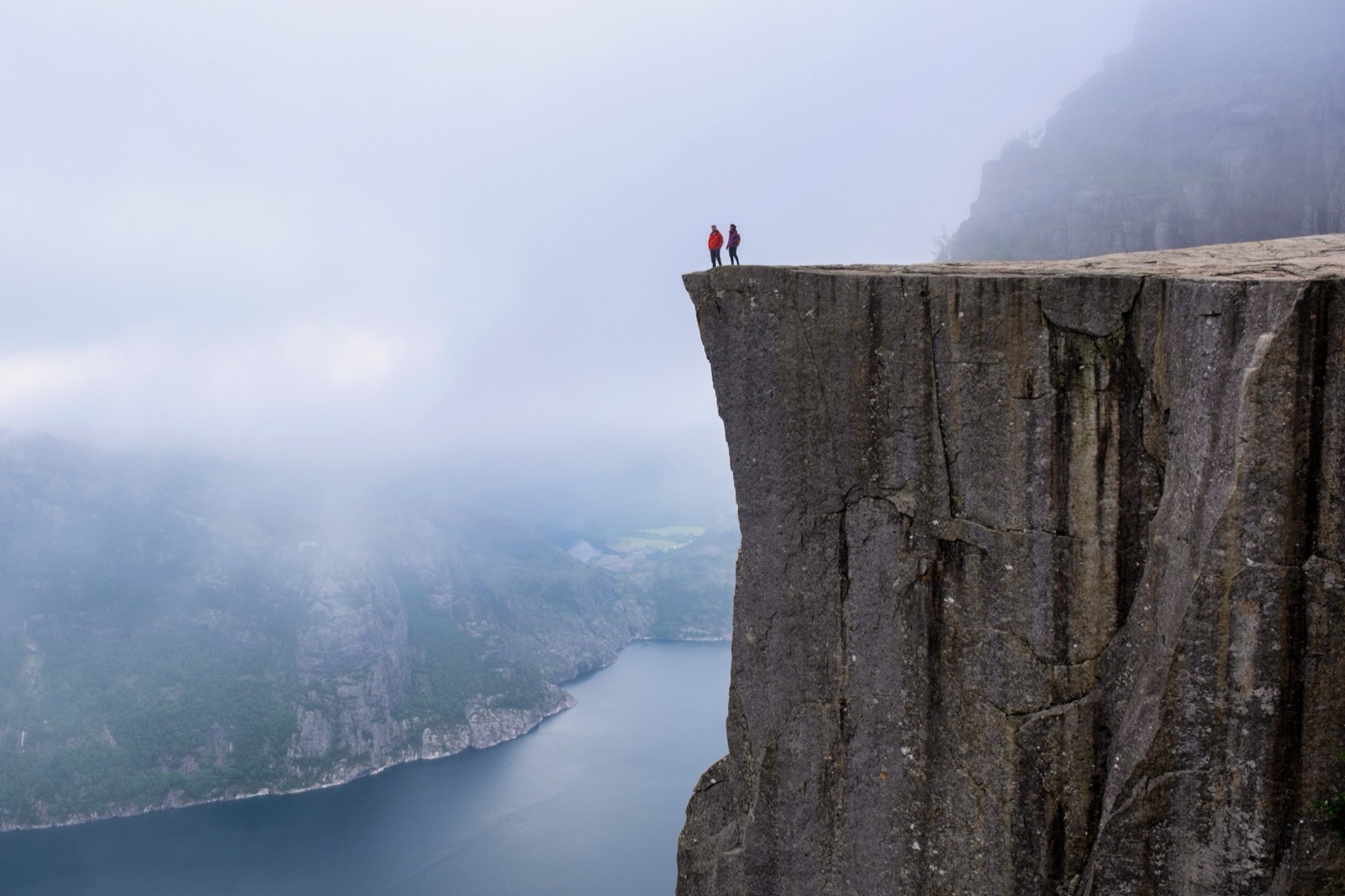
Preikestolen is dangerous in one specific way: it is a 604-metre cliff with no railings, visited by very large numbers of people, many of them inexperienced hikers. The rock itself is not the hazard; geologists have concluded it is stable. The risk is a slip, a misstep at the edge, or a hiker caught out by weather, ice, darkness or exhaustion. This article sets out what is on record, why the authorities have chosen not to fence the cliff, where accidents happen and how to keep the risk low.
The short answer
- Deaths are rare. The Local described the 2013 victim as the first tourist ever to fall from the rock.
- The two best-documented accidents: a fall from the plateau in 2013 and a slip on the approach in 2024.
- No railings: the plateau is unfenced by design, and the foundation’s visitor site asks everyone to keep a safe distance from the edge.
- The trail matters too: parts of the path run alongside high cliffs, and the 2024 accident happened before the plateau.
- Weather and winter raise the risk: conditions change quickly, and in winter the trail can be icy.
- Help is close but not instant: the trailhead is staffed year-round, and local volunteer rescuers are on standby around the clock.
- Emergency numbers: 113 for medical emergencies, 112 for the police.
The accidents on record
October 2013: a fall from the plateau
On 10 October 2013, The Local reported that a Spanish tourist had died after falling from Preikestolen. According to the local paper Strandbuen, quoted in the report, the man had gone back to take a few last photographs as his tour group was leaving the plateau. Moments later his companions heard a scream; his body was found in the fjord below.
The Local called him the first tourist ever to fall from the rock, at a time when it was receiving some 200,000 visitors a year. A former leader of the local hiking association, Stavanger Turistforening, told the Norwegian broadcaster NRK that they had always feared this could happen. The circumstances, a last photograph at the edge after the group had turned to leave, are worth remembering, because they describe exactly the moment when attention drops.
June 2024: a slip on the approach
On 3 June 2024, Dagbladet reported that a man had died at Preikestolen that Monday morning. He had slipped over an edge about 150 metres before the top of Preikestolen and fallen about 200 metres. He was found shortly afterwards by a rescue helicopter.
Police told CNN that the man, in his forties, was travelling alone and was found with his phone and ID. Two witnesses were questioned, including one who saw the accident and said the man slipped and fell. Police treated it as a fall accident with no suspicion of a crime. An alpine rescue group and a helicopter recovered the man, and that evening police reported the trail and the plateau open again for normal use.
The plateau was not evacuated. People who had seen the accident were met by health workers and police at the parking area by Preikestolhytta, and the mayor of Strand confirmed that psychosocial crisis staff were there to look after witnesses and others affected. It is a reminder that an accident on a busy cliff affects many more people than the person who falls.
This accident did not happen on the famous square platform. It happened on the way there, which is a useful correction to the idea that the only dangerous spot is the edge of the plateau.
How many people have died at Preikestolen?
There is no single, published death toll from the police, the municipality or the Preikestolen Foundation that we could find. Several websites quote totals and annual averages without naming a source; we have not repeated them, because we could not check them.
What can be said with confidence is the scale against which any number should be read. Visitor numbers have grown enormously: when visitors were first counted systematically, in 2008, about 118,000 people reached the ledge, and by 2022 the figure was about 350,000, making it the most walked of all marked mountain routes in Norway, according to Store norske leksikon. The foundation says peak summer days see up to 7,000 hikers, while most winter days see fewer than 100. Against those numbers, fatal accidents are very rare, which is one of the reasons given for not fencing the cliff.
Rare is not the same as impossible. Both accidents described above happened to visitors doing ordinary things, taking a photograph and walking the path, which is why the advice below is about habits rather than heroics.
Why there is no fence
Visitors are often surprised that one of Norway’s busiest attractions has no railing along a 604-metre drop. It is a deliberate choice. The authorities have opted not to install fencing or other safety devices, judging that it would detract from the site and that fatalities there are extremely rare. There was also a concern that fences might encourage dangerous behaviour, such as climbing onto them. Norwegian authorities have put the principle bluntly: the country cannot fence in all of its nature.
The foundation’s visitor site, Preikestolen 365, states the practical consequence without hedging. There are no railings or barriers at the cliff edge, and visitors must keep a safe distance, supervise children closely and avoid risky behaviour near the edge.
This fits a wider Norwegian approach to the outdoors. Under the right of access, hiking is allowed almost everywhere, and in return hikers are expected to behave responsibly. The foundation says hiking to Preikestolen is done at your own risk: even on a well-marked trail there is always a risk of accidents or sudden illness. Nobody is going to stop you walking to the edge. The judgement is yours.
Where the real risks are
The edge and the camera
The plateau is large, roughly 25 by 25 metres, and almost flat, so there is plenty of room to enjoy the view well back from the drop. The danger comes from deliberately getting close: sitting with legs over the edge, backing up to frame a picture, or stepping out for one more shot after a group has turned to leave, as in 2013. Wet rock, gusts of wind and crowds all make a small misjudgement worse.
The trail, not just the plateau
The foundation warns that part of the trail runs alongside high cliffs, where children in particular need close care. The final approach follows a ledge along the cliff onto the plateau. The 2024 accident happened on the way to the plateau, about 150 metres before the top. Keep to the marked path and the red T markings, and stay on the inside of the ledge when passing other people.
Weather
The foundation’s advice is that weather can change quickly, and that wind, rain, snow or ice can affect safety. Rain makes rock slabs and stone steps slippery; wind on an exposed plateau unsettles your balance; low cloud can hide the edge and the path. Check a local mountain forecast before you start and again before you step onto the plateau, and listen to staff at the trailhead.
Winter ice and darkness
The trail is open all year, but in winter it can be slippery and covered in snow and ice. The foundation advises using or renting crampons or spikes, especially when its hosts say so, and does not recommend hiking with children under five in winter. From September through March daylight is short, so start early and plan to be back before dark. Our Preikestolen hike guide covers winter hiking in detail.
Crowds
Crowding is a safety issue as well as a nuisance. In July 2020 the Preikestolen Foundation called the police after queues of cars stretched back to the main road. On the trail, many early starters create a crowd peak between 08:00 and 11:00 in summer. A busy plateau means people stepping around each other near the edge, so arriving at a quieter time is the simplest safety measure there is.
Fatigue and over-reaching
The foundation grades the hike as moderate: about 8 km and about 4 hours for the round trip, with around 500 metres of total ascent spread over several uphill sections. That is manageable for most reasonably fit people, but tired legs on the way down cause slips, and people who misjudge the effort can end up hurrying in fading light. Eat, drink and turn back if the day is going badly.
How the trail has been made safer
Much of the work on the trail over the past decades has been about safety as well as comfort. The Preikestolen Foundation, set up by the local municipalities and landowners, manages the parking area and the path day to day. Between 2013 and 2018, Sherpas from Nepal hardened large sections of the trail and cleared steep parts of boulders, laying hand-crafted granite steps that make for easier and safer hiking. Local carpenters built timber bridges at exposed points.
The foundation also has paid and voluntary staff monitoring safety and sanitation along the trail, and it publishes an hourly visitor forecast so that people can avoid the busiest times. None of this changes the edge itself, which is left as nature made it, but it does mean that most of the trail is now a well-built path rather than a scramble over loose rock.
Who comes when something goes wrong
The parking area at the trailhead is staffed year-round. Ask the staff about conditions before you set off, and listen to their advice, especially if they tell you not to go without proper gear.
Beyond the trailhead, rescue on the Lysefjord relies heavily on volunteers. The Strand og Forsand department of Norwegian People’s Aid, which works closely with the Preikestolen Foundation, has about 100 volunteers on standby, ready to respond 24/7, every day of the year. Even with a helicopter, work on a cliff takes time: in 2024 the man was found quickly, but the police expected the recovery operation itself to take five to seven hours.
In an emergency, call 113 for medical help or 112 for the police. If you can, stay where you are, keep warm and give clear information about your location.
The Norwegian mountain code, applied to Preikestolen
Norway has a short set of rules for safe hiking, the Mountain Code (Fjellvettreglene), created by the Norwegian Trekking Association (DNT) and the Norwegian Red Cross. Several of them apply directly to a day at Preikestolen:
- Plan your trip and tell someone. The foundation says the same: tell someone your plans and when you expect to be back.
- Adapt to ability and conditions. Travelling with others is safer; if you travel alone, exercise caution.
- Respect the weather. The weather changes quickly in the mountains, so bring extra clothing even on a short hike.
- Carry what helps rescuers find you. The code suggests a headlight or a high-visibility vest, which matters on sunrise hikes and short winter days.
- Don’t be ashamed to turn around. If the rock is icy, the wind is strong or the cloud is down, the view will still be there on another day.
The full code is published in English by the Norwegian Red Cross.
A safety checklist for the plateau
- Stay a few steps back from the edge; the view is just as good.
- If you do go closer, sit or crouch rather than stand, and never lean out.
- Never walk backwards while taking a photograph.
- Keep children within arm’s reach on the plateau and on the cliffside sections of the trail.
- Do not go near the edge in strong wind, rain, fog or icy conditions.
- Avoid the busiest hours, when people crowd the edges for pictures.
- Leave the drone at home: the foundation does not allow drones.
- Do not camp on the plateau; that is not allowed either.
Is the rock itself safe?
Many visitors notice the crack across the back of the plateau and wonder whether the whole block could fall. The answer from geologists is reassuring. A stability study completed in 2018 found that the crack does not run all the way through the rock, and NGU, the Geological Survey of Norway, describes Preikestolen as standing firm. Our article on Preikestolen’s height and geology explains the crack and the study in detail.
Children and people who fear heights
Families hike Preikestolen every summer, and most can do it safely with proper footwear and supervision. The foundation’s advice is to take particular care on the cliffside sections and not to bring children under five in winter.
If you are afraid of heights, most of the trail does not involve exposed edges. The plateau itself has no railings, and some people find the final viewpoint uncomfortable. It is perfectly reasonable to stop short of the platform, or to enjoy the view from a spot well back from the edge.
Hiking with a guide
The foundation recommends a guided tour, especially in winter or if you are less experienced. A guide sets the pace, knows where the trail is exposed and carries the right equipment for the conditions. Our tours page lists the hikes and cruises we link to, and our guide to getting to Preikestolen covers buses, parking and timing.
Frequently asked questions
Has anyone died falling from Preikestolen?
Yes. In October 2013 a Spanish tourist died after falling from the plateau while taking photographs; The Local called him the first tourist ever to fall from the rock. In June 2024 a man in his forties died after slipping about 150 metres before the top and falling about 200 metres.
How many people die at Preikestolen each year?
We found no published annual figure from the police or the Preikestolen Foundation, and totals on other websites are usually unsourced. Fatal accidents are rare compared with visitor numbers, which reached about 350,000 in 2022.
Is Preikestolen dangerous?
The hike is graded moderate and is done safely by hundreds of thousands of people a year. The danger lies in the unfenced 604-metre edge and the cliffside parts of the trail, and in weather, ice, darkness and fatigue; keeping back from the edge removes most of the risk.
Are there railings at Preikestolen?
No. The authorities chose not to fence the cliff, partly because fatal accidents are rare and partly because fences could encourage people to climb on them. The foundation asks visitors to keep a safe distance and supervise children closely.
Is Preikestolen safe for children?
Most families manage the hike safely in summer with good footwear and close supervision, especially near the cliffs. In winter the foundation does not recommend hiking with children under five.
What number do I call in an emergency at Preikestolen?
Call 113 for medical emergencies or 112 for the police. Stay where you are if you can, keep warm and describe your location as clearly as possible.