Preikestolen in Winter: Snow, Ice, Daylight, Spikes and Guided Hikes
Yes, you can hike Preikestolen in winter. The trail is open all year and the car park is staffed every day, but from roughly October to April the path is often covered in snow and ice, daylight is short and the weather on the plateau changes fast. You need shoe spikes or crampons when there is ice, warm layers, a torch and an early start. The trailhead foundation, Fjord Norway and Visit Norway all recommend a guide in winter, especially if you have not hiked on snow and ice before. Go well prepared and you may have the 604-metre cliff almost to yourself: most winter days see fewer than 100 hikers, against up to 7,000 on peak summer days.
This guide covers what winter actually means on the trail, the daylight you have to work with, what to wear and where to rent spikes, the guided winter options from Stavanger, how to reach the trailhead when the express buses have stopped, and when to turn back. For the route in summer, see the Preikestolen hike guide.
Is Preikestolen open in winter?
There is no gate and no closing date. Preikestolen Parking is open 24 hours a day, year-round, and the parking facilities are staffed all year. The staffing hours are shorter in winter, from 09:00 to 14:00, against 07:00 to 18:00 in summer.
What changes is the season around it:
- Preikestolen BaseCamp counts the winter season as October to April, when the path is often covered in ice and snow.
- Visit Norway treats October to April as winter and out of season for transport.
- The foundation’s own FAQ describes February and March as the months for spectacular snow-and-ice scenery, and November to January as usually very quiet.
Visiting out of season is becoming increasingly popular. It is also the time of year when the hike stops being a walk and becomes a proper mountain outing.
Why go in winter at all?
The honest answer is solitude and light. In summer the plateau can be busy from mid-morning, with queues for the classic photo at the edge. In winter, on a clear day, you may share it with a handful of people or nobody at all. January, February and March bring cool, crisp air and the stillness of Norway’s long, dark winter, and in those months Preikestolen and the Lysefjord are often blanketed in snow and ice. Visit Norway calls a winter trek with crampons on a snow-covered, icy trail an experience you will never forget.
The trade-off is that you give up flexibility. A summer hiker can wait out a shower or start late; a winter hiker has a short window, needs the right kit, and must be ready to call the day off. If that suits you, winter is the most memorable way to see the place.
What winter means on the trail
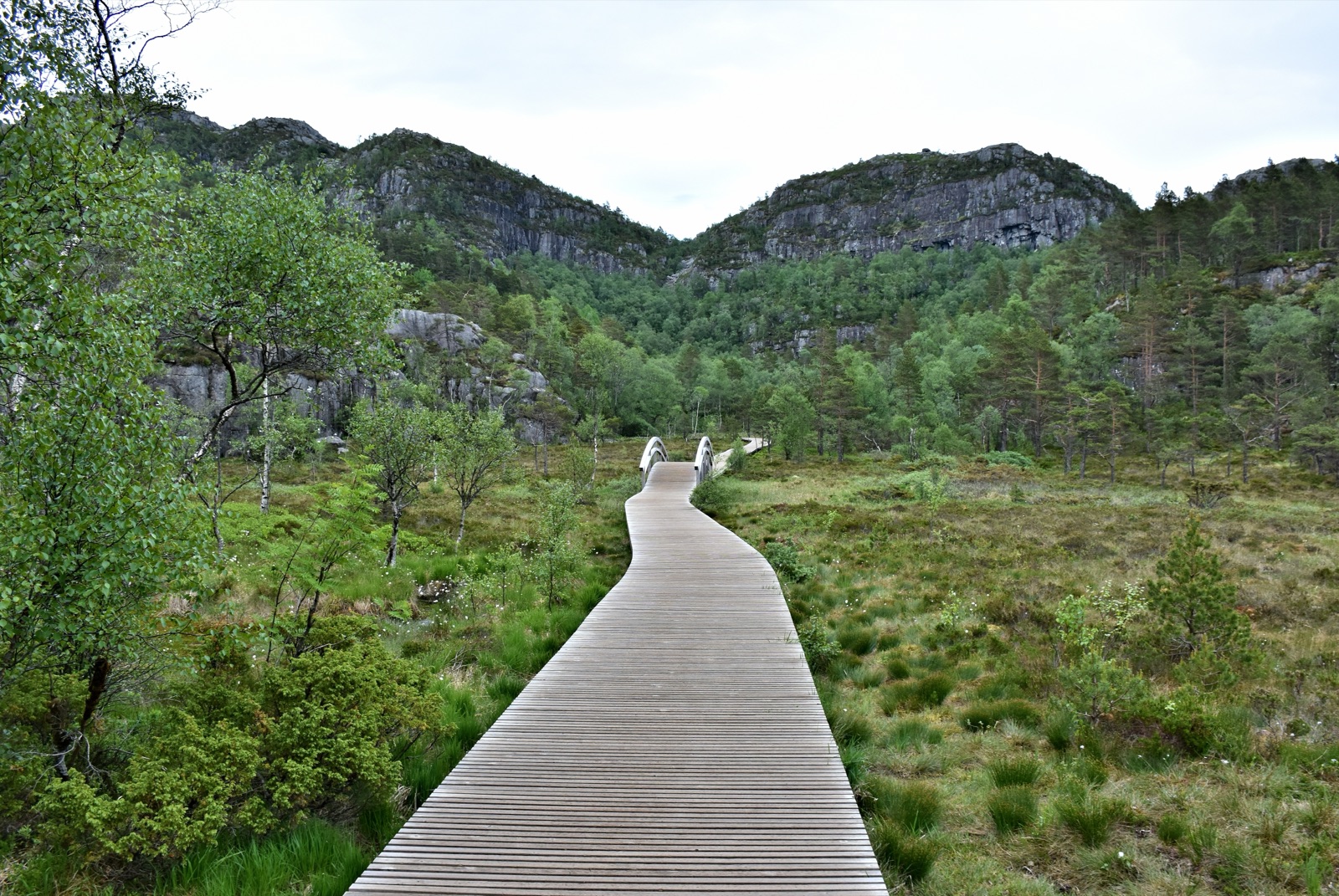
In summer the trail is a well-built path: a gravel road for the first 500 metres, then rocky sections, Sherpa-built stone steps and boardwalks over the boggy parts, about 4 km each way with 500 metres of total elevation gain. In winter the same route behaves differently.
- Ice and snow: the trail is often slippery and at times may not be visible at all.
- Hidden ground: snow can hide rocks, streams and cracks in the landscape.
- Cornices: near the cliffs, stand on solid ground, not on hardened snow that may have formed an overhanging edge.
- Markings: the trail is marked with red Ts painted on the rock. Because these can disappear under snow, reflective iron poles along the trail give the distance to Preikestolen and back to the trailhead.
- Footsteps: follow the marked trail, not just someone else’s footprints in the snow.
On a good day the winter path winds through quiet pine forest, past frozen lakes and over snow-dusted stone steps, and the view from the top is the same, framed by snow. On a bad day, ice and wind make the upper sections hard going even for experienced hikers.
October to April, month by month
The Preikestolen Foundation’s month table gives the typical temperature at the top, rainy days and sunshine, plus the latest time you should start the hike.
| Month | Average at the top | Rainy days | Sunshine a day | Don’t start after |
|---|---|---|---|---|
| October | 4°C | 24 | 3 hours | 1:00 pm |
| November | 0°C | 26 | 1 hour | 12:00 (midday) |
| December | -3°C | 24 | 1 hour | 11:00 am |
| January | -4°C | 22 | 1 hour | 11:00 am |
| February | -4°C | 20 | 3 hours | 12:00 (midday) |
| March | -1°C | 18 | 5 hours | 1:00 pm |
| April | 1°C | 17 | 6 hours | 3:00 pm |
Averages hide the extremes. The Liarvatn weather station, 8.1 km from Preikestolen, measured -15.9°C on 8 January 2026, and January 2026 averaged -3.0°C there against a normal of 0.3°C. The same winter brought a mild, very wet December 2025: 403.1 mm of precipitation, well above the normal of 293 mm. Expect anything from soft rain to hard frost, sometimes in the same week.
For a wider view of the year, see the Preikestolen weather guide.
Daylight: the real constraint
Most winter problems at Preikestolen come back to time. The hike takes about 4 hours round trip for most visitors in summer, and guided winter groups allow 2 to 3 hours each way. The shortest winter days last about 6.5 hours.
- On 15 November 2026 the sun rose in Stavanger at 08:28 and set at 16:13.
- On 1 December 2026 it rises at 09:03 and sets at 15:48.
- On 21 December 2026 it rises at 09:29 and sets at 15:40, giving 6 hours 11 minutes of daylight.
The earliest sunset of the winter is on 15 December and the latest sunrise on 27 December. That is why the foundation’s latest start time drops to 11:00 am in December and January, and why it asks hikers to respect it. Start early, plan to be back before dark, and always carry a torch or headlamp in case of delays. Do not expect the northern lights as compensation: Preikestolen is about 1,500 km south of the Arctic Circle, and the chance of seeing them there is close to zero.
Spikes, crampons and what to wear
The single most important piece of winter kit is traction. In winter, use or rent crampons or spikes, especially when the trailhead hosts tell you to.
Combining the packing advice from BaseCamp, the foundation and Rødne, a winter kit looks like this:
- Feet: warm hiking boots or mountain boots, wool socks, and ice cleats or shoe spikes.
- Hands and head: hat, scarf and mittens or gloves.
- Body: wool next to the skin, a warm mid-layer and warm, windproof outerwear, plus a spare set of clothes.
- Poles: poles with spikes help on icy slabs and steps.
- Light: a headlamp or torch, even if you plan to be down by early afternoon.
- Food and drink: snacks, water and a thermos with something hot. You cannot refill water along the trail.
- Comfort: a seat pad for the lunch break.
The guided winter hike listings add that hiking boots are required and that snowshoes or spikes are provided if conditions demand them.
Renting gear at BaseCamp
You do not need to fly in with crampons. The Adventure Centre at Preikestolen BaseCamp, beside the car park, rents hiking boots, spikes, warm clothing and backpacks all year, and its winter list specifically mentions ice cleats and poles with spikes for rent.
BaseCamp also has a café and restaurant, which makes a warm base before and after the hike. Toilets are only at the parking area; there are none on the trail.
Guided winter hikes
All three bodies that look after visitors here recommend a guide in winter, both for safety and for local knowledge. Two kinds of guided winter trip leave from Stavanger.
Guided hike with transport. Fjord Norway lists a guided winter hike that picks up from your accommodation at 7:00-7:15 am; be ready in front of your hotel 5 minutes before. The drive to the trailhead takes about 40 minutes, through the world’s longest and deepest undersea road tunnel. From the trailhead it takes 2-3 hours to reach the plateau and 2-3 hours back, and you are back at your accommodation around 3 to 4 pm. The listing gives 8 km, a total ascent of 400 m and a medium (blue) grade; the foundation’s own figure for the total elevation gain is around 500 metres. Food and drink are not included, and the standard group is up to 8 people.
Fjord cruise and guided hike. Rødne’s winter cruise and guided hike runs from November to April. In January to March and November to December it leaves Thursday to Sunday at 11:00, and in April daily at 11:00. The price includes the 2-hour fjord cruise, a guide, snow spikes if needed, poles, a head lamp, hot drinks and a packed lunch, transport and hotel drop-off. The day lasts 8-9 hours depending on the weather. It costs NOK 2790 for adults and NOK 2150 for children aged 8-15, is not allowed for children under eight, and is only available pre-booked.
Guided hikes with pickup in Stavanger are also on the tours page. Check each listing’s season and winter conditions before booking, and see Pulpit Rock tours compared for how the formats differ.
Going without a guide
Many people do hike Preikestolen alone in winter, and in calm, clear, cold weather with good spikes it can be a superb day. The foundation’s rules for doing it are worth following to the letter:
- Do not hike alone. The foundation strongly recommends against hiking alone outside peak season.
- Tell someone your plan and when you expect to be back.
- Talk to the staff first. The parking area is staffed year-round; ask about conditions and read the signs.
- Respect a no. If the staff say not to hike because of dangerous weather or trail conditions, respect that.
- Turn around early if you suspect conditions are becoming unsafe.
If you are unsure about navigating on snow or walking on ice, that is the clearest sign to book a guide.
Getting there in winter
The direct express buses from Stavanger to Preikestolen Parking do not run in the low season; the Go Fjords bus season is April to October. In winter public transport is limited, and a taxi is the recommended option for the last stretch.
- Bus and taxi: take Kolumbus bus no. 100 from Stavanger city centre to Jørpelandsvågen. The route runs Jørpelandsvågen - Førland - Solbakk - Hundvåg - Stavanger. From Jørpeland a taxi to Preikestolen BaseCamp takes approx. 10 minutes.
- By car: drive through the Ryfast undersea tunnel to Solbakk and follow the signs to Preikestolen car park, about 40 minutes from Stavanger. Parking costs NOK 275 for stays over 2 hours. If you are not used to winter driving, think twice: the cold season for driving in Norway runs from October to April, with ice, snow and darkness.
- Guided: the guided winter options above include transport from Stavanger.
The getting there guide has the full detail, including tolls and the car parks.
Children and dogs in winter
In summer most families can complete the hike. In winter the trail can be icy and exposed, and the foundation does not recommend hiking with children under 5 or with babies. Rødne’s winter cruise-and-hike does not take children under eight.
Dogs are a summer problem rather than a winter one: the foundation advises against them in summer because of the crowds. In winter the trail is quiet, but icy slabs are hard on paws, so bring a dog only if it is used to winter conditions.
Safety at the edge in snow
There are no railings or barriers at the cliff edge, and in winter the edge is harder to read. Snow builds up into overhangs, ice forms on the slabs closest to the drop, and low cloud can hide how close you are.
- Stay well back from the edge, further than you would in summer.
- Never step onto a snow lip near the cliff.
- Keep your spikes on for the plateau itself; it is often the iciest part.
- In wind, sit down to take photos rather than standing near the drop.
The weather at the top is colder, often windier and rainier than at the trailhead, and visibility can be worse. Do not be fooled by a calm, sunny car park.
When to turn back
Set a turnaround time before you start, based on the foundation’s latest-start table and sunset, and stick to it. Turn back earlier if:
- the ice is too hard or steep for your spikes;
- the red Ts and the poles become hard to follow;
- wind or cloud builds on the upper sections;
- anyone in your group is cold, slow or unsteady.
If you travel from far away, plan an extra day in the area, as the foundation suggests, so one bad forecast does not mean losing the hike.
Winter from the water
If the trail is out of the question, the Lysefjord still works in winter. Rødne’s Lysefjord cruise from Stavanger runs all year: from January to March it sails Thursday to Sunday at 11:00, and in April daily at 11:00. It runs regardless of the weather and passes beneath Preikestolen. In winter the fjord can have snow-covered mountains and frozen waterfalls, with eagles and seals to look out for. Ryfylke Adventure also offers boat trips to see Preikestolen from the Lysefjord all year round.
Kjerag, the Lysefjord’s other famous hike, is not an option in winter: the mountain roads to its trailhead are closed from November to mid-May. For the cruise details, see the Lysefjord cruise guide.
Frequently asked questions
Can you hike Preikestolen in winter? Yes. The trail is open all year, but it is often icy and snowy from October to April. You need spikes or crampons, warm clothing, a torch and an early start, and a guide is recommended if you lack winter hiking experience.
Do I need crampons for Preikestolen in winter? When there is snow and ice, yes: shoe spikes or crampons are the key piece of kit. You can rent them, along with boots and poles, at Preikestolen BaseCamp.
How long does the winter hike take? Guided winter groups allow 2 to 3 hours each way. Leave time for breaks and for slower going on ice, and start no later than the foundation’s latest start time for the month.
Is there a bus to Preikestolen in winter? Not a direct one. Take bus no. 100 to Jørpelandsvågen and a taxi of about 10 minutes to BaseCamp, drive yourself, or book a guided trip with transport.
What is the best winter month for Preikestolen? February and March, for snow-and-ice scenery and longer days than December and January. November is the wettest month in the foundation’s table.
Can children hike Preikestolen in winter? The foundation does not recommend it for children under 5 or babies, because the trail can be icy and exposed.