History
Pulpit Rock in Mission: Impossible and the History of Preikestolen
The cliff in the climax of Mission: Impossible – Fallout is Preikestolen, Pulpit Rock, above the Lysefjord near Stavanger. In the film it stands in for a mountain in Kashmir, where Tom Cruise and Henry Cavill fight on the plateau and over its edge. The scenes were shot in November 2017, when the production spent eight days on the rock, closed it completely to the public for three of them and flew in 120 tonnes of equipment by helicopter. On 1 August 2018, a few days before the Norwegian premiere, 2,000 people hiked up to watch the film on a giant screen on Preikestolen itself.
The film is one chapter in a much longer story. Local people knew it as Hyvlatonnå, the “plane’s tooth”, long before anyone called it a pulpit. According to the trail’s own history, a Stavanger bank manager “discovered” it for tourism in 1896; a farm became a hikers’ lodge, a hut was built in 1949, a road arrived in 1961, and Nepalese Sherpas rebuilt the trail in the years before and after the film crew came. This article tells both stories: how the shoot happened, and how a fjord ledge became one of Norway’s best-known sights.
The short answer
- The film: Mission: Impossible – Fallout (2018), the sixth film in the series, directed by Christopher McQuarrie.
- The scene: the climax, set in Kashmir; the helicopter chase was filmed in New Zealand, and the fight on the cliff at Preikestolen.
- When: preparation, filming and clean-up ran from 2 to 9 November 2017.
- The logistics: a crew of about 140 on average, 120 tonnes of equipment, 10 helicopters and 800 flights.
- The screening: an outdoor pre-premiere on the rock on 1 August 2018, for 2,000 people.
- Can you stand there? Yes. The plateau is on the public trail, open all year.
The scene: Kashmir, played by Norway
Fallout ends in the mountains of Kashmir, or so the film tells you. As The Hollywood Reporter explained when the film came out in 2018, director Christopher McQuarrie used two locations to build the chase. Cruise and the others race through the green mountains of New Zealand in helicopters, and then, through editing, Cruise and co-star Henry Cavill end up on top of Preikestolen. The two men fight on the plateau and just over its edge, with the Lysefjord far below.
The rock fitted the brief for obvious reasons: a flat, square platform ending in a vertical drop of 604 metres, and no railings to edit out. The trail’s managers describe it as one of the key filming locations for one of the film’s most important action scenes. A Visit Norway press release from 2023 puts it more simply: Preikestolen was the backdrop for the cliffhanger finale.
Project “Gemini”: how the shoot was arranged
Filming on Fallout ran from April 2017 to March 2018, in Paris, the United Kingdom, New Zealand, the United Arab Emirates and Norway. In spring 2017 the local authorities learned that Preikestolen was being considered as a location. Rogaland County Council asked Stiftelsen Preikestolen, the foundation that manages the trail, to do two jobs: coordinate between the film company and the local authorities, and host the production on site on behalf of the landowners.
To keep a low profile, all communication about the shoot used a project name, “Gemini”. The foundation and the municipality of Forsand, where the rock then lay, worked with Truenorth, the Icelandic production company hired by Paramount Pictures.
Granting the licence was not a formality. Norway’s right to roam means anyone may walk freely in nature, so an exemption had to be granted before Preikestolen could be closed to the public while the crew worked. In return, Paramount accepted a long list of conditions, the most important being that local providers should be used as far as possible:
- Local mountaineers and rescue teams handled climbing, rigging and safety.
- Norwegian People’s Aid, the volunteer rescue organisation, contributed 1,000 hours of volunteering and in return received a significant financial contribution, used to fund future search and rescue around the Lysefjord.
- Most of the crew stayed at Preikestolen Mountain Lodge, by the trailhead, while Tom Cruise stayed at a private property and was flown directly to the rock.
- Local chefs worked alongside the production’s own kitchen staff.
Eight days in November
The shoot was originally planned for 20-28 September 2017. Then Tom Cruise injured his leg on the London set, the studio stopped production for at least nine weeks, and filming at Preikestolen was moved to November, with the risk that winter weather would stop work altogether.
Preparations, filming and clean-up at Preikestolen took eight days, from 2 to 9 November 2017, with a crew of about 140 people on average. The numbers give a sense of the operation:
- 120 tonnes of equipment were flown up and back down.
- 10 helicopters made 800 flights between them.
- No landings on the plateau: to protect the rock and the vegetation, everything was lowered from the air.
- Three days of complete closure to the public while the cameras rolled; access was restricted for the rest of the period.
Wind delayed the first day of filming, but the delays were caught up and the filming itself took only just over two days. The timing turned out to be lucky. The day after Cruise left the set, heavy snow fell at Preikestolen, the start of a long, snowy winter.
Accounts of the closure differ. A Visit Norway spokesperson told The Hollywood Reporter in August 2018 that the production had closed the rock for 10 to 14 days. We follow the foundation’s more detailed account, which was written by the people who hosted the shoot: eight days of work on site, three of them fully closed.
Tom Cruise on the cliff
Little was said publicly during filming about what Cruise was doing on set. It is well known that he performs his own stunts, and the foundation reports that much of his work at Preikestolen involved climbing the last metres of the cliff himself, hanging 604 metres above the Lysefjord. Leaving, McQuarrie thanked the people of Norway on behalf of the crew, signing off with the Norwegian tusen takk, a thousand thanks.
The screening on top of Preikestolen
Fallout had its world premiere in Paris on 12 July 2018 and was released in the United States on 27 July 2018. The Norwegian premiere was planned for 3 August. Before that, Preikestolen got its own.
The idea came from Forsand’s mayor, Bjarte Dagestad, who had met McQuarrie, Cruise and Cavill on set. With Paramount’s permission, an outdoor pre-premiere was held on the plateau on 1 August 2018. The details explain why people still talk about it:
- The screen: a laser projector showed the film on a canvas screen 14 by 9 metres, with full surround sound.
- The tickets: all 2,000 sold out in just 10 minutes.
- The show: it started at 11pm and lasted 2 hours and 25 minutes.
- The walk down: at 1:30 in the morning, 2,000 people walked down the 4-kilometre trail, lit by 200 torches, with Norwegian People’s Aid making sure everyone got down safely.
Norwegian actor Kristoffer Joner, who plays a nuclear researcher in the film, was there. Cruise was not, but he posted a drone photograph of the outdoor cinema on Instagram, and he, McQuarrie and Cavill recorded a video message that was shown to the audience on the rock.
What the film left behind
The foundation reports that no permanent negative effects on the local plants and wildlife have been registered since the shoot. On the publicity side, it expects the film’s exposure to cinema audiences worldwide to have raised awareness of Preikestolen and the Lysefjord, an effect that is hard to measure in visitor numbers but likely to last.
The film itself did well. Its total production budget was 178 million US dollars, and by January 2019 it had earned almost 800 million US dollars, according to the foundation’s account.
Mission: Impossible came back to Norway
The franchise returned. A Visit Norway press release of 6 July 2023 described how Dead Reckoning Part One used other Norwegian locations, including a motorcycle jump off the 1,246-metre Helsetkopen near Hellesylt, close to the Geirangerfjord, and a fight on the roof of a train on the Rauma Railway. The same release looked back at Preikestolen as the backdrop for the Fallout finale, with the story set in India, the country that administers the part of Kashmir shown in the film.
Preikestolen on screen before and after
Fallout was not the rock’s first appearance. The foundation lists car commercials, Bollywood productions, concerts and music videos among earlier projects, and in 2015 Lonely Planet ranked Preikestolen number 1 on its list of the world’s most breathtaking viewing platforms.
Two other screen moments come up often:
- Vikings: in the final scene of the second season of the TV series, Ragnar Lothbrok is seen sitting on top of Preikestolen, which explains searches for “Pulpit Rock Vikings”.
- Ko: a song in the Tamil-language film shows the lead couples dancing on top of the cliff.
The rock has also travelled in stone. A granite sculpture of the cliff stands in Langeskov in Denmark, marking its twinning with Forsand.
The name: plane’s tooth and preacher’s chair
Before tourists came, local people called the rock Hyvlatonnå. Store norske leksikon explains that the square ledge looks like the steel blade of a woodworking plane seen on edge, hence the “plane’s tooth”.
The tourist name came later. According to Wikipedia’s account of the name, Prekestolen was coined around 1900, when Stavanger Turistforening, the local hiking association, wanted to promote the site, and the i was added later to match Nynorsk, the written form of Norwegian used locally. Preike means to preach and stol means chair, so Preikestolen is literally the “preacher’s chair”. In English that is a pulpit, a raised stand for Christian preachers, and the rock does tower over the fjord like one.
The “discovery” of 1896
The story told by the trail’s managers begins in 1896. Thomas Peter Randulff, a bank manager from Stavanger, was a passenger on the steamboat Oscar II on the Lysefjord when he noticed the striking rock on the northern cliffs. Captain Hana recognised it and explained that it looked like the blade of a wood planer, which was why locals called it the plane’s tooth.
Randulff, an active member of the Norwegian Hiking Association, decided to be the first visitor to hike to the top. With his friend Ole Hausken, an accountant, he set off from sea level, as there were no roads. They climbed along a stream and around a lake to the farm at Vatne, where the trailhead is today. The widow who ran the farm had not heard of a rock called Preikestolen, but her sons, Elling and Guttorm, offered to help, and they needed another local, Fredrik Bratteli of Neverdalen farm, to find it. The photograph Randulff took of Elling, Guttorm and Ole on the rock in 1896 is the ancestor of the picture almost every visitor takes today.
Store norske leksikon gives a different starting date: it says the first tourists found their way to the ledge in 1905, and wrote afterwards about their “conquest”. Both accounts describe the same route. Early visitors took the boat from Stavanger to the quay at Refsa, climbed the steep path up to the lake at Refsvatnet, and then followed roughly the same path used today.
From farm lodging to Preikestolhytta
By the lake lay two small farms, Torsnes and Vatne, and both offered lodging to hikers. The foundation’s history fills in the dates:
- 1920: the Stavanger Hiking Association furnished 3 rooms at Vatne farm so that people could stay overnight.
- 1921: the trail between Vatne and Preikestolen was marked.
- 1925: neighbouring Torsnes became a tourist station, which ran until the 1960s.
- The 1920s: Vatne and Torsnes reported about 100 guests a year.
- 1946: the association acquired Vatne farm.
- 1949: it opened Preikestolhytta, a hut with 44 beds.
Building the hut was an expedition in itself. A stone quay was built at sea level at Refså, and a cableway hoisted the materials up 240 metres. Boats carried everything across Lake Refsvatnet, and a trolley track covered the last stretch. Timber came from the surrounding forests, sawn at a makeshift sawmill by the lake.
Roads, crowds and a foundation
In 1961 a road was built from Jøssang, near Jørpeland, to Preikestolhytta, and Preikestolen became a day hike. From the 1960s visitor numbers grew steadily, reaching 50,000 a year in the 1990s. Growth brought arguments: an idea to build a lift from sea level to the rock caused a heated debate.
The answer was management rather than machinery. In 1992 Rogaland County Council passed a land-use and management plan for the rock, and in 1993 Stiftelsen Preikestolen, the Preikestolen Foundation, was set up. It is a non-profit body in which the local municipalities and landowners are represented, and it still runs the parking area and trail. From 1993 to 1996 local contractors hardened and widened the trail with stone from the area.
The numbers kept rising: about 75,000 hikers in 2004, about 118,000 in 2008 when visitors were first counted systematically, about 300,000 in 2018 and about 350,000 in 2022, by which time it was the most walked of all marked mountain routes in Norway.
Sherpa steps and a national trail
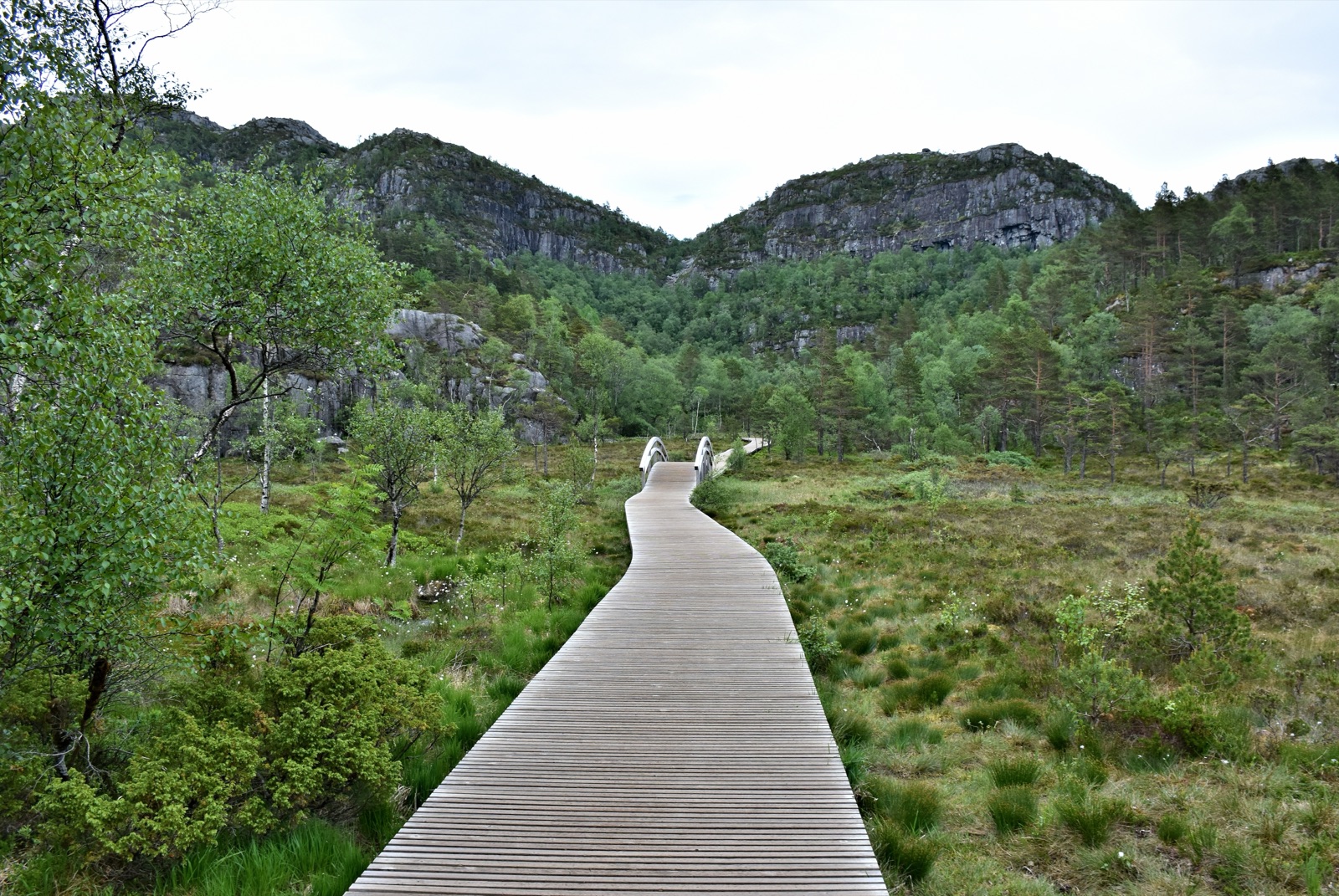
The new Preikestolen Mountain Lodge (Preikestolen fjellstue in Norwegian), designed by the Norwegian architects Helen & Hard, opened in 2008 and won a national architecture award in 2009. From 2013 to 2018, Sherpas from Nepal were brought in to rebuild the trail, hardening large sections and laying the hand-crafted granite steps that hikers climb today. Wikipedia dates the main path project from 2013 to its completion by 2016; we follow the foundation’s own dates.
The last few years have brought further changes. Preikestolen fjellstue, the lodge at the trailhead built on the old Vatne farm, was sold to private interests in 2019. In 2020 the route of just over four kilometres to the rock was certified as a national hiking trail, and the municipal reform of the same year moved the north side of the Lysefjord, with Preikestolen, from Forsand to Strand municipality. Since 2018 the parking area and trailhead facilities have operated every day of the year.
Standing where the fight was filmed
The plateau in the film is the same plateau every hiker reaches, and you can visit it at any time of year. Our guide to the Preikestolen hike covers the distance, timing and season, and our guide to getting to Preikestolen covers the buses and parking. To see the cliff from the fjord below, our Lysefjord cruise guide compares the boats. Hikes and cruises we link to are on our tours page.
Two points if the film is your reason for going. Drones are not allowed at Preikestolen, so the aerial shots stay in the cinema. And the cliff edge has no railings: please do not try to recreate the scenes. Our article on Preikestolen deaths and safety explains why, and our piece on the rock’s geology explains the crack you will see at the back of the plateau.
Frequently asked questions
Where was the Mission: Impossible cliff scene filmed?
The cliff-top fight at the end of Mission: Impossible – Fallout was filmed on Preikestolen, above the Lysefjord near Stavanger in Norway. In the film the location is presented as Kashmir; the helicopter chase before it was filmed in New Zealand.
When was Mission: Impossible filmed at Preikestolen?
Preparations, filming and clean-up took place from 2 to 9 November 2017. The rock was fully closed to the public for the three days of filming, and the shooting itself took just over two days.
Did Tom Cruise really hang off Preikestolen?
According to the foundation that hosted the shoot, much of Cruise’s work there involved climbing the last metres of the cliff himself, hanging 604 metres above the Lysefjord, with local mountaineers and rescue teams engaged for the climbing and safety work on the shoot.
Can you visit the Mission: Impossible cliff?
Yes. The plateau is at the end of the public trail from the Preikestolen trailhead, which is open all year. There are no railings, and drones are not allowed.
Who discovered Preikestolen?
Local people already knew the rock as Hyvlatonnå. The trail’s managers credit Stavanger bank manager Thomas Peter Randulff with the first tourist hike to the top in 1896, while Store norske leksikon dates the first tourists to 1905.
What does Preikestolen mean?
Preikestolen means “the preacher’s chair”, which is a pulpit in English. The older local name, Hyvlatonnå, means the “plane’s tooth”, after the rock’s resemblance to the blade of a woodworking plane.